


Is 40 Minutes of Deep Sleep per Night Enough?
Table of Contents
- What Deep Sleep Actually Does for Your Body
- Is 40 Minutes of Deep Sleep per Night Enough?
- Signs of Deep Sleep Deprivation You Should Not Ignore
- How to Track Sleep Quality Accurately at Home
- How to Improve Deep Sleep Naturally
- Where Supplements Fit Into a Deep Sleep Plan
- Frequently Asked Questions
Last Updated: September 19, 2026
What Deep Sleep Actually Does for Your Body
Deep sleep is the stage where your body does its heaviest repair work. It is the slow-wave phase of non-REM sleep, when your brain waves slow right down and your body prioritises physical recovery over dreaming.
During this stage, your body:
- Repairs muscle and tissue
- Strengthens the immune system
- Clears waste from the brain
- Consolidates memory and learning
- Regulates blood sugar and hormones
This is why you can sleep eight hours and still wake up foggy. Time in bed is not the same as time in deep sleep. The NHS guidance on sleep and tiredness makes the same point: quality matters as much as quantity.
For busy professionals juggling stress and screen time, deep sleep is usually the first thing to suffer. And it is the stage your body fights hardest to protect.
Is 40 Minutes of Deep Sleep per Night Enough?
For most healthy adults, 40 minutes of deep sleep per night sits at the lower end of the normal range but is not automatically a problem. Deep sleep typically makes up 13 to 23 per cent of total sleep time.
So if you sleep seven hours, that works out at roughly 55 to 95 minutes of deep sleep. Forty minutes is below that band, but it depends on your age, your total sleep time, and how you feel during the day.
Here is the honest answer most guides avoid: a single number on a tracker means very little on its own. What matters is the pattern over weeks, plus how you actually function.
How Deep Sleep Changes Across the Night
Deep sleep is front-loaded. You get most of it in the first two or three sleep cycles, which is why an early night beats a late one.
Each cycle runs about 90 minutes (What happens when we sleep?). Deep sleep is heaviest in the first half of the night, then tapers off as REM sleep takes over towards morning.
This has a practical consequence. If you go to bed at 1am and wake at 7am, you are cutting into the window where deep sleep is most available. Going to bed an hour earlier often adds more deep sleep than any supplement can.
Signs of Deep Sleep Deprivation You Should Not Ignore
The clearest signs of deep sleep deprivation show up in how you feel and function, not just in your tracker data. Watch for these:
- Waking after a full night and still feeling unrested
- Mental fog and slow recall in the morning
- Cravings for sugar and caffeine by mid-afternoon
- Getting ill more often than usual
- Low mood or short temper over small things
- Slow recovery from exercise or physical strain
One rough night is normal. A fortnight of these signs together is your body asking for a change.
A common mistake is to treat these as a willpower problem. They are not. They are usually a sleep architecture problem, and architecture responds to routine, not resolve.
How to Track Sleep Quality Accurately at Home
The most accurate way to track sleep quality at home is to combine a wearable with a simple written log. No consumer device measures brain waves directly, so treat every deep sleep figure as an estimate.
Here is how to get useful data:
- Wear your tracker consistently, including weekends
- Note your bedtime, wake time, and any night wakings
- Record how you feel at 10am and 3pm each day
- Log caffeine, alcohol, and late screens
- Review the week, not the night
The Sleep Foundation guide to sleep trackers notes that consumer devices vary in accuracy, especially for staging. Use the trend, not the single reading.
If your tracker says 40 minutes but you feel sharp and steady, trust how you feel. If it says 90 minutes and you feel wrecked, that is the signal worth acting on.
How to Improve Deep Sleep Naturally
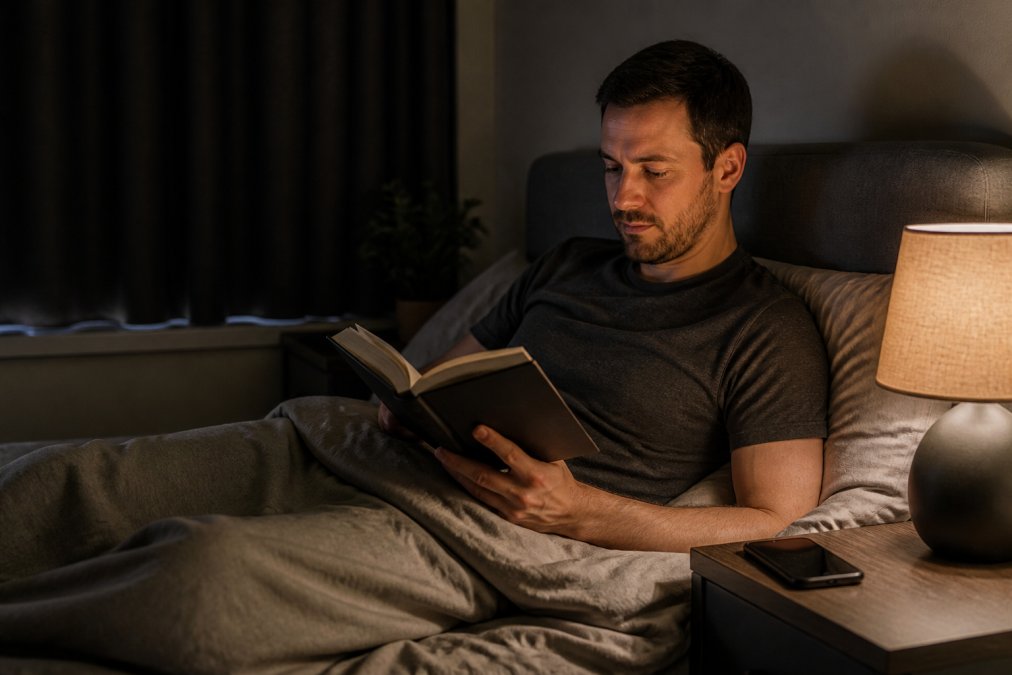
The fastest natural route to more deep sleep is a consistent wind-down that starts hours before bed. Your body builds the sleep signal through the evening, and most modern routines sabotage it.
Try these, in order of impact:
- Fix your wake time first. A steady wake time anchors your body clock better than a steady bedtime.
- Cut caffeine after midday. Caffeine has a long half-life and still blocks deep sleep at 4pm.
- Dim the lights two hours before bed. Bright light tells your brain it is still daytime.
- Keep the room cool and dark. A cooler core temperature helps you drop into slow-wave sleep.
- Move your body earlier in the day. Late intense training can delay sleep onset.
- Leave alcohol out of the evening. It helps you fall asleep, then fragments the second half of the night.
What most guides miss is the order. Nailing your wake time and caffeine cut-off usually does more for deep sleep than any single bedtime trick.
Where Supplements Fit Into a Deep Sleep Plan
Supplements support a deep sleep plan. They do not replace one. The basics, light, timing, caffeine and a cool dark room, do the heavy lifting.
That said, some people run low on the raw materials their body uses to wind down. Magnesium and the tryptophan pathway are the two most common gaps, especially during stressful stretches.
At Octi Nutrition, we build our sleep products around that idea rather than around knocking you out. The Sleep Stack pairs 5-HTP and L-tryptophan with 376mg of magnesium per daily dose, plus vitamins B6 and B12. Vitamin B6 contributes to normal psychological function and to the reduction of tiredness and fatigue.

If you prefer to build your own routine, the individual pieces are available too:
| Product | What It Supports | Daily Dose Highlights | Price |
|---|---|---|---|
| Sleep Stack | Wind-down pathway and relaxation | 5-HTP, L-tryptophan, 376mg magnesium, B6, B12 | £27.00 |
| 5 HTP with L-Tryptophan | Serotonin production and restful sleep | One capsule daily, 90-day supply | £12.50 |
| Double Magnesium | Muscle function, stress relief, relaxation | 376mg magnesium per daily dose | £14.50 |
Every batch is made in a GMP-certified UK facility with independent lab testing, and a Certificate of Analysis is available on request. If you take prescription medication, speak to your GP before adding anything new.


Deep sleep is not a score to beat. It is a signal that your routine is working. If 40 minutes is your number and you feel sharp, keep doing what you are doing. If you feel foggy and flat, start with your wake time, your caffeine cut-off, and a proper wind-down.
At Octi Nutrition, we make evidence-led sleep support for people who cannot afford to run on empty. Our Sleep Stack combines 5-HTP, L-tryptophan and 376mg of magnesium, made in a GMP-certified UK facility with independent lab testing on every batch. Build your stack and give your body the raw materials it needs to reach deep sleep and stay there.
Frequently Asked Questions
What is the recommended amount of deep sleep for adults?
Most adults spend roughly 13 to 23 per cent of total sleep time in deep sleep. On a seven to eight hour night, that works out at about 55 to 110 minutes. Forty minutes sits below that typical band, though the figure shifts with age, since deep sleep declines naturally from your thirties onwards. Treat it as a rough target rather than a pass or fail score.
Why am I only getting 40 minutes of deep sleep?
Common causes include late caffeine, alcohol in the evening, a warm or bright bedroom, irregular bedtimes, and stress that keeps your nervous system switched on at night. Screen time close to bed and heavy meals late in the evening also interfere. Because deep sleep is concentrated in the first half of the night, a delayed bedtime cuts directly into the stage your body needs most.
Can nutritional supplements help improve deep sleep naturally?
Supplements can support the pathways your body already uses to wind down, but they work alongside the basics rather than replacing them. Magnesium contributes to normal psychological function and the reduction of tiredness and fatigue, and formulas that pair it with 5-HTP and L-tryptophan support the wind-down chain. Give any approach thirty days of consistent use before judging it, and speak to your GP first if you take prescription medication.
How can I track sleep quality accurately without a wearable?
A simple sleep diary is more useful than most people expect. Record your bedtime, wake time, number of night wakings, and how you felt on waking, scored one to five. Do this for two weeks before drawing conclusions. Wearables can add detail, but they estimate stages from movement and heart rate rather than measuring brain activity, so use the trend rather than any single night's number.