


Gut Microbiome Test vs Stool Test: Which Matters
Table of Contents
- Gut Microbiome Test vs Stool Test: The Core Difference
- What Does a Stool Test Check For
- Gut Microbiome Test Accuracy and What It Reveals
- How to Collect a Stool Sample Correctly
- Gut Microbiome Test Results Explained
- Which Test Should You Choose
- Moving Beyond Testing: Supporting Gut Health With Supplements
- Conclusion
- Frequently Asked Questions
Last Updated: October 13, 2026
Gut Microbiome Test vs Stool Test: The Core Difference
When comparing a gut microbiome test vs stool test, they sound like the same thing, but they're not. Understanding what separates them matters if you're trying to identify what's actually happening in your digestive system.
A stool test is a broad diagnostic tool. It checks for parasites, bacterial infections, digestive enzymes, fat absorption, and inflammatory markers. Think of it as a general health snapshot: does your gut have an infection? Are you absorbing nutrients properly? Is inflammation present?
A gut microbiome test is narrower in focus. It sequences the DNA of the bacteria living in your gut to identify which species are present and in what quantities.
The practical difference: a stool test is diagnostic (finds problems). A microbiome test is descriptive (shows you what you've got). You might need one, the other, or both depending on your symptoms and what you're trying to understand about your health.
At Octi Nutrition, we work with busy professionals who often ask which test they should actually take. If you're optimising your gut health and want to understand your bacterial composition to guide supplementation, a microbiome test gives you that map.
What Does a Stool Test Check For
A stool test examines your faeces for markers that reveal how your digestive system is functioning. It's one of the oldest diagnostic tools in medicine, and it remains one of the most useful.
Stool tests typically screen for:
- Parasites and pathogenic bacteria, identifies infections like Giardia, Cryptosporidium, or pathogenic E. coli strains that cause acute illness
- Digestive enzyme markers, shows whether your pancreas is producing enough enzymes to break down food
- Fat absorption, measures undigested fat, indicating whether your small intestine is absorbing nutrients properly
- Inflammatory markers, identifies inflammation in the gut lining through markers like calprotectin
- Occult blood, detects bleeding in the digestive tract not visible to the naked eye
- pH and short-chain fatty acids, indicates the chemical environment your bacteria are living in
A stool test is most useful when you have active symptoms: chronic diarrhoea, constipation, unexplained weight loss, or suspected food poisoning. It answers the question, "What's wrong?" rather than "What have I got?"
The limitation: a standard stool test won't tell you much about your overall bacterial diversity or which beneficial species dominate your microbiome. It's looking for problems, not cataloguing your entire microbial community.
:::pro-tip If you've had digestive symptoms for more than two weeks, a stool test from your GP is usually the first step before considering microbiome testing. It rules out active infections or absorption problems that need treating first.
Gut Microbiome Test Accuracy and What It Reveals
A microbiome test sequences bacterial DNA from your stool sample to identify which species live in your gut and how abundant they are. It's a snapshot of your microbial ecosystem at a single point in time.
What it reveals:
- Bacterial diversity, the number of different species present. Higher diversity generally correlates with better health outcomes, though this isn't absolute (pubmed.ncbi.nlm.nih.gov).
- Dominant strains, which bacteria make up the bulk of your community. Firmicutes and Bacteroidetes typically dominate a "healthy" microbiome, but ratios vary.
- Keystone species, bacteria that have outsized influence on your gut environment, even if they're not the most abundant
- Functional capacity, some tests infer what metabolic processes your bacteria can perform based on their species composition
The accuracy question is important. Microbiome tests are accurate at identifying which bacteria are present, DNA sequencing is reliable. What they're less reliable at is telling you whether your microbiome is "good" or "bad." The reference data for what a "healthy" microbiome looks like is still evolving, and individual variation is enormous.
Two people with completely different bacterial communities can both be perfectly healthy. What matters more is whether your specific community is stable, diverse, and supports your individual health outcomes.
A microbiome test is most useful if you're optimising an already-functioning gut, not diagnosing acute problems. If you're taking probiotics or prebiotics and want to see whether they're actually shifting your bacterial composition, a microbiome test shows you that. If you have chronic, low-grade digestive issues and want to understand your baseline before starting a protocol, it provides that baseline.
The limitation: it doesn't tell you whether you have an infection, whether you're absorbing nutrients, or whether inflammation is present. Those require a traditional stool test.
How to Collect a Stool Sample Correctly
Collection accuracy matters. A contaminated or improperly stored sample can skew results, especially for microbiome testing where you're trying to preserve the bacterial composition.
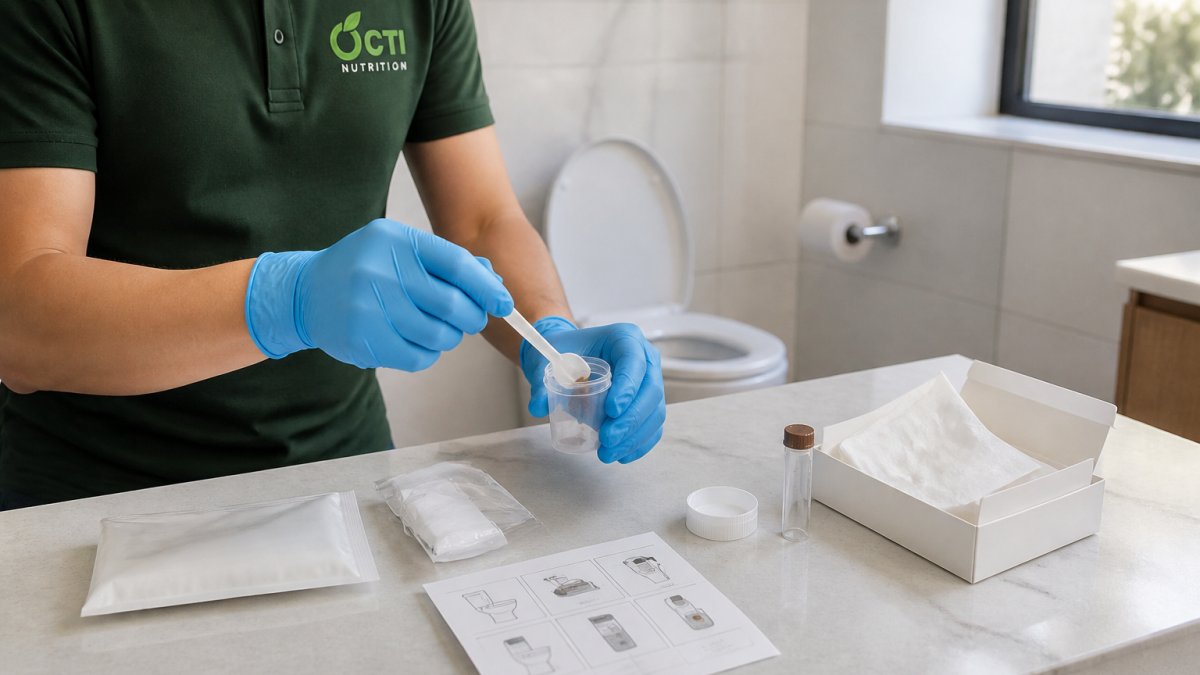
The process:
-
Use the kit provided, your test kit includes sterile containers and collection tools. Use only these. Contamination from toilet water, paper, or other sources invalidates results.
-
Collect mid-stream, avoid the first and last portions of your bowel movement. The middle section is most representative of your gut bacteria.
-
Fill to the line, don't overfill or underfill. The kit specifies how much sample you need for accurate analysis.
-
Seal immediately, close the container tightly to prevent contamination and preserve the bacterial composition.
-
Store correctly, most kits include stabilising solution. If yours does, mix the sample thoroughly. Refrigerate if you can't post the sample immediately, and don't leave it at room temperature for more than a few hours.
-
Post promptly, send your sample within 24 hours of collection if possible. Bacterial composition changes over time, especially at room temperature.
Common mistakes: collecting from toilet water (dilutes the sample), using non-sterile containers, waiting days before posting, or not sealing the container properly. Any of these can compromise your results.
Gut Microbiome Test Results Explained
Your results arrive as a report showing bacterial composition, diversity scores, and often a comparison to "healthy" reference populations. Here's how to read them without overthinking.
Diversity metrics, typically shown as Shannon Index or Simpson Index. Higher numbers indicate more bacterial species present. A score in the upper range is generally positive, but don't panic if yours is lower.
Dominant phyla, your report will show what percentage of your microbiome is Firmicutes, Bacteroidetes, Actinobacteria, and others. A rough 60:40 Firmicutes to Bacteroidetes ratio is common, but variation is normal.
Specific strains flagged as "beneficial" or "depleted", some tests highlight species associated with good health outcomes (like Faecalibacterium prausnitzii) or note if common beneficial species are absent.
Functional predictions, some tests infer metabolic capacity (can your bacteria produce butyrate? process fibre?). These are estimates based on species composition, not direct measurements.
Comparison to reference, your results might say your diversity is in the "lower 25%" or your Firmicutes ratio is "elevated." Remember: reference populations vary by geography, diet, and age.
Which Test Should You Choose
The choice depends on what you're actually trying to understand.
Choose a stool test if:
- You have active digestive symptoms (diarrhoea, constipation, bloating, pain)
- You suspect a parasitic or bacterial infection
- You're experiencing unexplained weight loss or malabsorption
- You want to rule out inflammation or bleeding before investing in optimisation
- Your GP has recommended testing
A stool test is also more likely to be covered by the NHS if your symptoms warrant investigation, making it the practical starting point for most people.
Choose a microbiome test if:
- Your digestion is generally functional but you want to optimise it
- You're considering probiotic or prebiotic supplementation and want a baseline
- You want to track whether dietary changes or supplements are shifting your bacterial composition
- You're interested in understanding your individual microbiome profile
- You've already ruled out infections or absorption problems
Choose both if:
- You have chronic, low-grade digestive issues that aren't acute but aren't resolving either
- You want diagnostic clarity (stool test) plus a map for optimisation (microbiome test)
- You're building a comprehensive gut health protocol
For most busy professionals, the practical approach is this: if you have symptoms, start with a stool test through your GP. If you're symptom-free but want to optimise your gut health, a microbiome test gives you a useful baseline. If you're already taking supplements and want to know whether they're working, a microbiome test shows you the shift.
| Test Type | Best For | Cost Indicator | Timeline | Key Limitation |
|---|---|---|---|---|
| Stool Test | Active symptoms, infection screening | Often NHS-covered | Results in 1-2 weeks | Doesn't map bacterial diversity |
| Microbiome Test | Optimisation, baseline mapping | Private cost | Results in 2-3 weeks | Doesn't diagnose acute problems |
| Both Together | Comprehensive assessment | Higher cost | Staggered results | Time and expense |
Moving Beyond Testing: Supporting Gut Health With Supplements
Testing gives you information. Supplements give you tools to act on it.
If your stool test shows low digestive enzyme output, you might benefit from enzyme support. If your microbiome test shows depleted beneficial bacteria, you're looking at probiotics and prebiotics. The key is matching your supplementation to what your tests actually revealed, not taking a generic "gut health" formula.
Pre + Pro 15 (£18.50) is built for this. It contains 15 strains of live cultures at 15 billion CFU per serving, paired with fructo-oligosaccharide (FOS) prebiotic fibre that feeds those bacteria. The B-vitamin complex supports energy metabolism and mucous membrane integrity, relevant if your microbiome test showed you need bacterial support or if you're rebuilding after an infection.

If you're starting a more comprehensive gut reset, the Gut Reset Stack (£37.50) pairs Pre + Pro 15 with Black Walnut & Pumpkin Seed Intestinal Cleanse (£19.50). The cleanse is a traditional herbal preparation rich in tannins and polyphenols, designed to support intestinal health before you rebuild with live cultures.
The logic is straightforward: you test to understand what you're working with, then you supplement based on what the test reveals. Generic supplementation without testing is expensive guesswork. Testing without follow-up supplementation is information without action.
:::pro-tip If you're on blood pressure medication or any prescription, check with your GP before starting supplements. Magnesium in pumpkin seed and some probiotic strains can interact with certain medications. Your GP can confirm whether any of our products are safe for your specific situation.
Conclusion
A gut microbiome test and a stool test are different tools answering different questions. A stool test diagnoses problems; a microbiome test maps your bacterial ecosystem. Most people benefit from understanding which one they actually need before investing in testing.
If you're serious about improving your gut health, testing gives you a baseline and direction. From there, targeted supplementation, like Pre + Pro 15 or the Gut Reset Stack, lets you act on what you've learned rather than guessing. Build My Stack →

Frequently Asked Questions
Is a gut microbiome test the same as a stool test?
No. A stool test identifies pathogens, parasites, and digestive markers that indicate disease or dysfunction. A gut microbiome test sequences DNA from bacterial populations to show which species are present and their relative abundance. Stool tests answer 'what's wrong?'; microbiome tests answer 'what bacteria do I have?' Both use stool samples, but they measure different things and serve different purposes.
What can a clinical stool test diagnose?
Clinical stool tests check for infections (bacterial, viral, parasitic), inflammatory markers, fat malabsorption, and the presence of blood. They're ordered when you have symptoms like chronic diarrhoea, abdominal pain, or unexplained weight loss. Your GP requests these tests when they suspect a specific condition. Microbiome tests, by contrast, don't diagnose disease, they profile bacterial composition.
Are at-home gut microbiome tests accurate?
At-home microbiome tests are technically accurate at identifying which bacteria are present, but accuracy depends on proper sample collection and the lab's methodology. The bigger limitation is interpretation: knowing your bacterial ratios doesn't automatically tell you what to do about them. Results require expert analysis to be actionable. If you suspect infection or disease, a clinical stool test ordered by your GP is more appropriate.
How do I know if I need a stool test or microbiome test?
Ask yourself: do I have symptoms suggesting infection or disease (persistent diarrhoea, pain, blood in stool)? If yes, request a clinical stool test from your GP. If you're managing your health proactively and want to understand your bacterial composition to optimise digestion and immunity, a microbiome test may help. Many professionals use both: a clinical test rules out problems; a microbiome test guides supplementation strategy.